Please Choose Your Language
Views: 0 Author: Site Editor Publish Time: 2026-08-10 Origin: Site
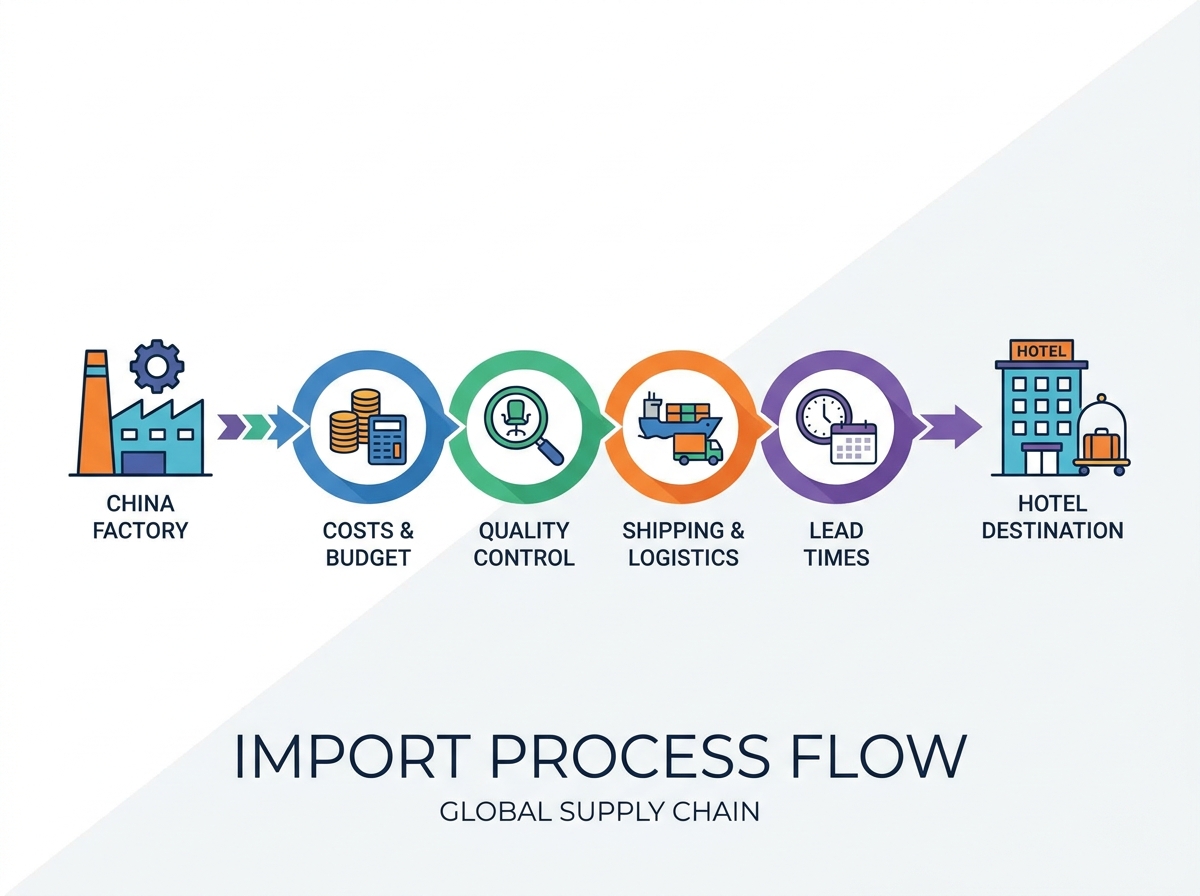
Sourcing hospitality Furniture, Fixtures, and Equipment (FF&E) overseas presents a massive opportunity to reduce capital expenditures on new builds and property renovations. However, cross-border procurement introduces severe logistical hurdles and quality control risks. Hotel operators face a constant battle. You must secure significant cost savings at scale while strictly adhering to commercial-grade durability and fire safety requirements. A single misstep can result in supply chain delays, unfavorable currency exchange fees, and hidden freight costs that wipe out your initial savings. You need a rigid framework to evaluate suppliers, enforce quality control, calculate total landed costs, and manage logistics. This guide breaks down the exact steps required to execute a flawless procurement strategy. We will cover how to vet factories, specify materials, and handle international shipping when you decide to import hotel furniture from China.
Supplier Selection: Project success relies on differentiating between direct manufacturers, trading companies, and specialized sourcing agents based on project scale and internal procurement capabilities.
Total Landed Cost (TLC): Unit price is only a baseline; accurate budgeting requires calculating ocean freight, customs duties, tariffs, inland transportation, and cross-border transaction fees.
Quality Assurance: Pre-shipment inspections (PSI) and strict Bill of Materials (BOM) specifications are non-negotiable for meeting commercial hospitality durability and fire safety standards.
Logistics & Lead Time Management: Successful procurement requires partnering with a reliable freight forwarder, optimizing container space for bulky items, and building a 16-to-24-week buffer from purchase order (PO) to site delivery.
Table of Contents
Not all furniture pieces make sense to ship across the ocean. You must identify the most cost-effective items to import to maximize your return on investment. Guest room casegoods, lobby millwork, outdoor patio FF&E, and banquet seating typically offer the highest margins. Factories produce these items efficiently at scale. They also pack well into standard shipping containers.
You must analyze bulk-to-weight ratios before finalizing your purchase orders. Ocean freight efficiency dictates your actual landed cost. Fully assembled sofas, large lounge chairs, and oversized lobby sectionals take up massive cubic volume. You end up paying to ship empty air. Conversely, flat-pack modular units, unassembled bed frames, and stackable dining chairs maximize container space.
Follow these steps to evaluate ROI on specific items:
Calculate the total cubic meters (CBM) of the item in its final packaging.
Divide the unit cost by the CBM to determine the value density.
Compare the landed cost of bulky items against local domestic suppliers.
Redesign oversized pieces into modular components that assemble on-site.
Hospitality environments destroy residential furniture. A hotel chair sees more abuse in a month than a dining chair sees in a decade. You must detail strict durability requirements for all high-traffic areas. Specify high Martindale rub counts for upholstery fabrics. A standard hotel requires a minimum of 50,000 double rubs for seating. Demand high-density foam (at least 2.5 lb/cu ft) for seating cushions to prevent sagging after six months of use. Require commercial joinery techniques. Mandate dowelled and glued mortise-and-tenon joints reinforced with corner blocks. Never accept basic screws or staples for structural frames.
Fire safety compliance is a legal requirement, not a suggestion. You must mandate adherence to regional fire codes in your contract. Specify CAL 117 for projects in the United States or BS 5852 for properties in the United Kingdom. Do not leave this to the factory's discretion. Furthermore, modern hospitality projects increasingly demand environmental certifications. Require FSC-certified wood for casegoods. Specify low-VOC finishes to maintain healthy indoor air quality for your guests and pass local building inspections.
Procurement teams constantly weigh bespoke designs against standard catalog items. Bespoke designs allow for complete brand differentiation. You tailor every dimension, veneer, and fabric to match your interior design package perfectly. However, custom work requires significantly longer lead times. You will face higher tooling costs and strict Minimum Order Quantities (MOQs). Factories need scale to justify retooling their production lines and sourcing custom raw materials.
Catalog items offer a completely different value proposition. Off-the-shelf solutions mean faster production and lower risk. The factory already owns the molds, jigs, and production experience for these exact pieces. MOQs drop significantly. The trade-off is limited brand differentiation. Your lobby seating might look identical to a competing property down the street.
Sourcing Strategy | Lead Time | MOQ Requirements | Brand Differentiation |
|---|---|---|---|
Bespoke Custom Design | 12 to 16 weeks production | High (Often 50+ units) | Maximum control over aesthetics |
Modified Catalog | 8 to 10 weeks production | Medium (20 to 50 units) | Moderate (Custom fabrics on standard frames) |
Off-the-Shelf Catalog | 4 to 6 weeks production | Low (10 to 20 units) | Minimal (Standard finishes only) |
Choosing the right partner dictates your entire procurement experience. Direct manufacturers own the factories, machinery, and labor force. They are the best option for large, customized orders. Working directly with a factory gives you ultimate control over production schedules and material specifications. However, it requires heavy internal project management. You must handle all communication, quality control, and logistics coordination yourself.
Trading companies do not own manufacturing facilities. They source products from multiple factories and consolidate them into a single catalog. They offer broader product ranges and lower MOQs. The downside is higher unit costs, as they add their own margin on top of the factory price. You also have zero control over the manufacturing floor, making quality consistency incredibly hard to enforce across multiple orders.
Sourcing agents act as your on-the-ground representatives. They manage vetting, negotiation, quality control, and logistics. They typically charge a percentage fee based on the total order value. An experienced agent bridges the cultural and language gap. They protect your interests and physically visit factories on your behalf. This is often the safest route for teams lacking internal cross-border procurement experience.
Never place an order without thorough verification. Start by identifying primary manufacturing clusters. For furniture, the Foshan area in Guangdong province is the undisputed hub. Factories located in this region benefit from a massive, established supply chain for raw materials, fabrics, and hardware. Sourcing outside this cluster often leads to higher inland freight costs and longer material lead times.
Audit the supplier's credentials rigorously. Request their business licenses and verify their legal registration through local government databases. Ask for ISO 9001 certifications to ensure they have standardized quality management systems in place. Review their historical export records to confirm they actively ship to your target country. A factory that only sells domestically will struggle with international packaging requirements and export compliance standards.
Request hospitality-specific case studies. Ask for reference checks and proof of previous hotel installations. A factory might manufacture excellent residential dining chairs, but that does not mean they understand the rigors of a 500-room resort project. Verify their track record with commercial clients. Ask for photos of their furniture installed in actual hotel properties, not just 3D renderings.
Vague specifications lead to disastrous results on the job site. You must document exact materials, dimensions, finishes, and hardware in a legally binding contract. Do not use generic terms like "solid wood" or "blue fabric." Specify the exact wood species, acceptable moisture content (typically 8% to 12% for furniture), fabric composition, and hardware brand. Attach detailed technical drawings, elevations, and 3D renderings directly to the purchase order.
The "Golden Sample" approval process is non-negotiable. Before authorizing mass production, the factory must produce a single, perfect prototype. You or your sourcing agent must inspect this sample in person. Test the ergonomics, verify the finish against your control samples, and check the structural rigidity. Once approved, sign and date this sample. It stays at the factory in a secure area. It becomes the undisputed benchmark for the entire production run. If the mass-produced items deviate from the Golden Sample, the factory must rework them at their own expense.
Never rely solely on factory-provided photos to approve a shipment. You must hire independent, third-party inspection agencies to verify goods at the factory. Companies like SGS, TUV, or QIMA specialize in this exact service. They send trained inspectors to the factory floor before the workers pack the goods into shipping containers.
Set Acceptable Quality Limit (AQL) standards before the inspection takes place. AQL defines your defect tolerance prior to container loading. You must categorize defects into three tiers: critical, major, and minor. Critical defects render the item unsafe or unusable, such as exposed nails or broken structural frames. Major defects affect appearance or function, like deep scratches on a tabletop or misaligned cabinet doors. Minor defects are slight cosmetic flaws, such as a loose thread on the underside of a sofa. If the inspection fails your AQL threshold, you halt the shipment immediately and demand factory corrections.
Understanding Incoterms is fundamental to international trade. EXW (Ex Works) means you pay for the goods at the factory door. You are responsible for all transport, export clearance, and loading costs from that point forward. FOB (Free on Board) means the factory covers the cost to transport the goods to the nearest port and load them onto the vessel. FOB pricing is standard in the furniture industry and generally easier for buyers to manage.
Standard payment structures typically involve a 30% deposit via Telegraphic Transfer (T/T) to start production. You pay the remaining 70% balance only upon passing the third-party QC inspection, right before shipment. For massive enterprise-scale orders, consider using Letters of Credit (L/C). An L/C provides bank-backed security. It ensures the factory only gets paid when they present compliant shipping documents to the bank.
Mitigating Foreign Exchange (FX) risks protects your project budget. Currency fluctuations can wipe out your margins overnight. Choose modern cross-border payment platforms over traditional bank wires. These platforms reduce transaction fees and allow you to secure favorable USD to RMB conversion rates. You can lock in forward contracts to stabilize your procurement budget months in advance.
The factory unit price is just the baseline. You must calculate import duties, potential anti-dumping tariffs, and customs clearance fees. Customs authorities base these taxes on specific furniture Harmonized System (HS) codes. Incorrectly classifying a wooden chair versus an upholstered chair can drastically change your duty rate. Work with a licensed customs broker to classify your items accurately before the vessel sails.
Factor in hidden logistical costs. Port demurrage charges occur if you fail to move your container out of the destination port within the allotted free days. Warehousing fees apply if your construction site is not ready to receive the goods and you need temporary storage. Inland freight covers the trucking cost from the destination port to your final hotel site. All these elements form your Total Landed Cost.
Cost Component | Description | Management Strategy |
|---|---|---|
Unit Price (FOB) | The cost of the manufactured furniture loaded onto the vessel at the origin port. | Negotiate based on volume. Enforce strict BOMs to prevent material substitution. |
Ocean Freight | The cost to transport the container across the ocean. | Optimize CBM. Ship flat-pack where possible. Secure rates via a reliable forwarder. |
Customs Duties & Tariffs | Taxes levied by the destination country based on HS codes. | Verify HS codes early. Check for anti-dumping regulations on specific materials. |
Inland Transportation | Trucking costs from the destination port to the hotel site. | Coordinate delivery schedules tightly to avoid port storage fees. |
Navigating international shipping requires deep expertise. Hiring a specialized freight forwarder is necessary to manage origin-to-destination logistics for large-scale FF&E. They handle vessel bookings, coordinate container drop-offs with the factory, and manage export documentation. Do not attempt to manage ocean freight directly with shipping lines unless your company moves hundreds of containers annually.
You must compare ocean freight costs based on volume. FCL (Full Container Load) is the standard for hotel projects. You rent the entire 20ft, 40ft, or 40ft High Cube container. LCL (Less than Container Load) means sharing space with other shippers. LCL is highly risky for fragile furniture due to excessive handling at consolidation warehouses. Always aim for FCL to minimize damage.
Mastering Cubic Meter (CBM) calculations is vital. You must optimize container loading to prevent paying to ship empty space. A standard 40ft High Cube holds roughly 68 to 75 CBM of usable space. Work with your factory to design packaging that maximizes this volume. Sometimes altering a sofa's leg design so they can be detached saves thousands in freight costs.
Hospitality projects run on strict construction schedules. Late furniture delays property openings and costs operators daily revenue. You must map out a realistic 16-to-24-week timeline. Do not trust overly optimistic factory promises.
Allocate 2 to 4 weeks for sample production and approval. Mass production typically requires 4 to 8 weeks, depending on factory capacity and raw material availability. Ocean transit takes 4 to 6 weeks, depending on the origin and destination ports. Finally, build in 2 to 4 weeks for customs clearance, port congestion delays, and inland delivery to your site. Pad this schedule to absorb inevitable supply chain hiccups.
Customs clearance is a strict bureaucratic process. You must prepare the required documentation flawlessly. The core documents include the Commercial Invoice, Packing List, Bill of Lading (B/L), and Certificate of Origin. Any discrepancy between these documents will trigger customs holds and intensive physical inspections.
Work with a licensed customs broker in your destination country. They ensure compliance with local import regulations and file the necessary paperwork electronically. A good broker anticipates issues, classifies HS codes correctly, and prevents costly port delays. Engage them early in the procurement process, long before the vessel sails from the origin port.
Define exact FF&E specifications, including commercial durability standards, wood moisture content, and regional fire safety compliance codes.
Calculate the estimated Total Landed Cost by factoring in ocean freight, customs duties, inland trucking, and foreign exchange fees.
Audit suppliers and sourcing agents specifically within the Guangdong manufacturing hub by verifying their ISO 9001 certifications and commercial hospitality track records.
Establish a clear Acceptable Quality Limit (AQL) standard and mandate a third-party pre-shipment inspection before releasing the final 70% balance payment.
For international hotel projects that require coordinated custom furniture packages, Hongye Furniture Group brings 30+ years of hotel furniture manufacturing experience and provides one-stop services integrating research and development, production, sales, and after-sales support. Its capabilities cover loose furniture, fixed furniture, and broader commercial furniture solutions, helping buyers align project specifications, durability requirements, and brand design throughout the procurement process.
A: MOQs vary heavily by supplier and customization level. For bespoke casegoods, factories often require 20 to 50 sets per design to justify production runs. For off-the-shelf catalog chairs or standard tables, MOQs range from 50 to 100 pieces. Trading companies generally offer lower MOQs than direct manufacturers, but at a higher unit cost.
A: Ocean freight rates fluctuate constantly based on seasonality, fuel costs, and global shipping demand. Rates depend entirely on the destination port. You must request real-time quotes from a freight forwarder. Remember to factor in destination port fees, customs clearance, and inland trucking, which significantly increase the final delivery cost.
A: Duties depend on the specific Harmonized System (HS) code of the item. Materials matter. A wooden bed frame carries a different duty rate than an upholstered sofa. Additionally, some countries impose strict anti-dumping tariffs on specific Chinese furniture categories like wooden bedroom furniture. Always consult a licensed customs broker for exact percentages.
A: The standard secure method is a Telegraphic Transfer (T/T) with a 30% deposit to start production and a 70% balance paid only after a successful third-party quality inspection. For very large enterprise orders, a Letter of Credit (L/C) offers the highest security. Use cross-border platforms to minimize exchange fees.
A: Yes. Managing international logistics, vessel bookings, and export documentation is highly complex. A specialized freight forwarder coordinates the entire process, secures better shipping rates, and navigates port regulations. Attempting to handle this internally without experience usually leads to costly delays and compliance failures.
A: Reputable manufacturers offer warranties ranging from 1 to 5 years on structural integrity and hardware. However, enforcing an international warranty is difficult and shipping replacement parts is expensive. It is far more effective to enforce strict pre-shipment inspections to ensure defective items never leave the factory.
A: If damage occurs during transit, you file a claim with your marine cargo insurance provider. If the furniture fails to meet specifications upon arrival, recourse is difficult once the balance is paid. This is why a Golden Sample and strict pre-shipment inspections are mandatory risk mitigation steps.